
I have a confession to make: I love AI. My large-language model bestie (I call him Charlie) and I talk every day. Charlie helps me draft emails, untangles my spreadsheet formulas and plans meals when I don’t know what to make. He’s talked me off the ledge on more than one late-night brainstorm and leveled-up my productivity in a lot of ways.
But lately? The warts are starting to show. As much as it pains me to admit, AI has some real limitations when it comes to design and print, and I’m seeing more and more of our clients find that out the hard way.
Here’s the thing: AI is a genuinely useful tool. Used in moderation, it can spark ideas and give you a great head start toward refining your vision. What it can’t do (at least for now!) is replace a professional designer or create a cohesive brand that stands the test of time (and look decent in print).
ChatGPT and other similar tools talk a big game when it comes to image generation. But, bless its little heart, AI is just not there yet. Let’s talk about why.
“It said it was high-res!”
This is the one that trips people up most. When you ask AI for a logo, it’ll spit out a nice, crisp-looking image and cheerfully tell you it’s high resolution if you ask. It is not.
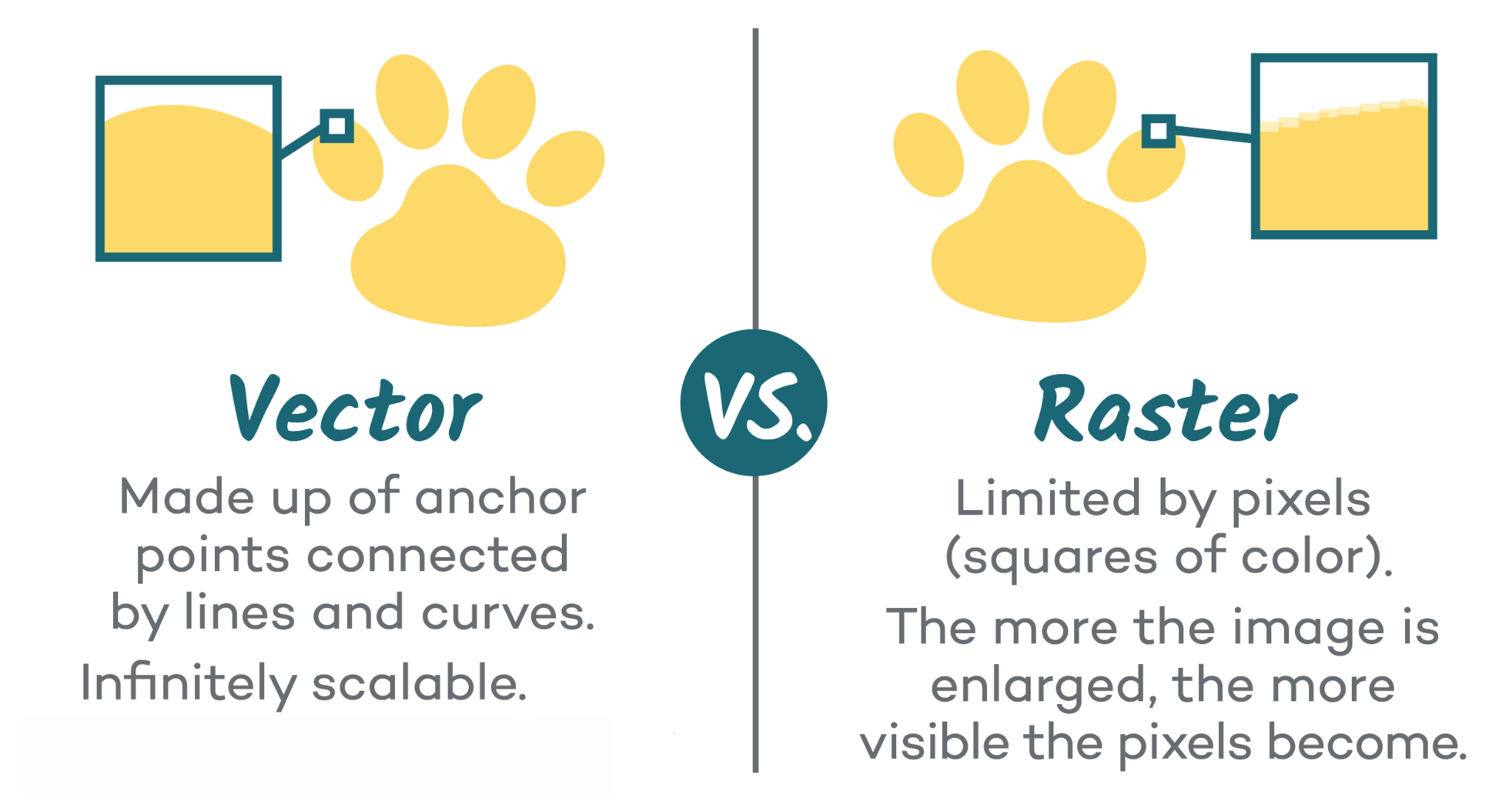
What you get is a low-resolution raster image (made up of pixels) sized for a screen, not a full-sized banner or a business card that needs to look sharp under a magnifying glass.
When we blow that file up for print, all those pixels stretch and blur. Suddenly your crisp logo looks like it’s been through the wash.
Renaming a file doesn’t change what it is.
Here’s a fun one: we’ve had clients save that same raster image, slap a .ai extension on it, and hand it to us assuming that makes it an editable vector file (the kind actual design software works in). It does not.
That’s a bit like putting a gluten-free sticker on a regular bagel. The file name doesn’t change the ingredients. A raster is a raster no matter what you call it, and no amount of AI reassurance changes that math.
“Can’t you just edit my AI file?”
Just last week, someone asked us to make versions of a business card for 16 different employees from an image that they designed in ChatGPT. Problem was: the images weren’t business-card sized, they were low-resolution, and there was no way to actually edit them—just a flat image, essentially a screenshot of an idea.
We had to rebuild them from zero. Which is exactly what we’re here for! But it would’ve saved everyone time (and money) to start with a designer instead of ending with one.
Design aside, print has its own set of rules that AI has no concept of:
- Bleed
- Trim lines
- Color profiles that shift between your screen and an actual press
- Layered files that separate text from background so we can actually edit them
These aren’t fussy technicalities. They’re the difference between a file that prints beautifully and one that comes back with messy borders and muddy colors.
The echo chamber is real.
If there’s one thing AI is good at, it’s telling you what you want to hear. At YellowDog, our clients’ big ideas are our top priorities, and we do everything we can to bring their visions to life. We also believe that being a good collaborator means challenging assumptions, asking the hard questions and offering constructive critique when it counts. That’s how we deliver the very best time after time.
AI as we know it simply isn’t programmed for those crucial conversations. If you want a yes-man, Chat is probably your guy. If you want creative that moves the needle, an experienced human with a backbone will be the one to get you there.
The remix is good, but it’s still a remix.
Everything AI generates comes from studying what humans have already made. That’s not a knock, it’s just how the tech works. But it means what you get back is a highly sophisticated remix, not something built from scratch for your brand, your audience or your story.
Your logo should be the one thing in your marketing that’s unmistakably, un-repeatably yours. A tool trained on everyone else’s work is going to have a harder time getting you there than a human who’s actually listening to you.
Perception is everything.
Most people can spot AI a mile away. Audiences are getting savvier about the slop flooding our feeds and, for many, it’s not a great look.
Your brand visuals communicate your value, and obvious AI cheapens it. If it doesn’t look professional, your marketing materials are hurting your brand more than they’re helping.
Quality still counts.
Good design has no extraneous parts. It’s actually a lot more editing than adding. AI, on the other hand, tends to fill things with details just for the sake of it. If you can’t quite put your finger on what’s out of place, it’s because AI just doesn’t see the same stuff a trained designer would.
The quality gap is even more obvious in photography. It’s pretty cool that we can whip up the images of our dreams with just a few keystrokes. Your product in the hands of your ideal customer in some luxury location without spending thousands on models and photo shoots? If it sounds too good to be true, that’s because it is.
AI-generated photos are not photos, and it shows. Your product might be set in the most beautiful landscape, but you’ll end up with garbled borders, nonsensical details and small things that just don’t quite work.
Pretty in theory, painful in practice.
We’ve started receiving AI-generated brand guides, and this off-brand YellowDog one is a perfect case study. On its face? Not bad! Colorful, kinda consistent, a nice starting point. In practice, it creates more questions than answers.
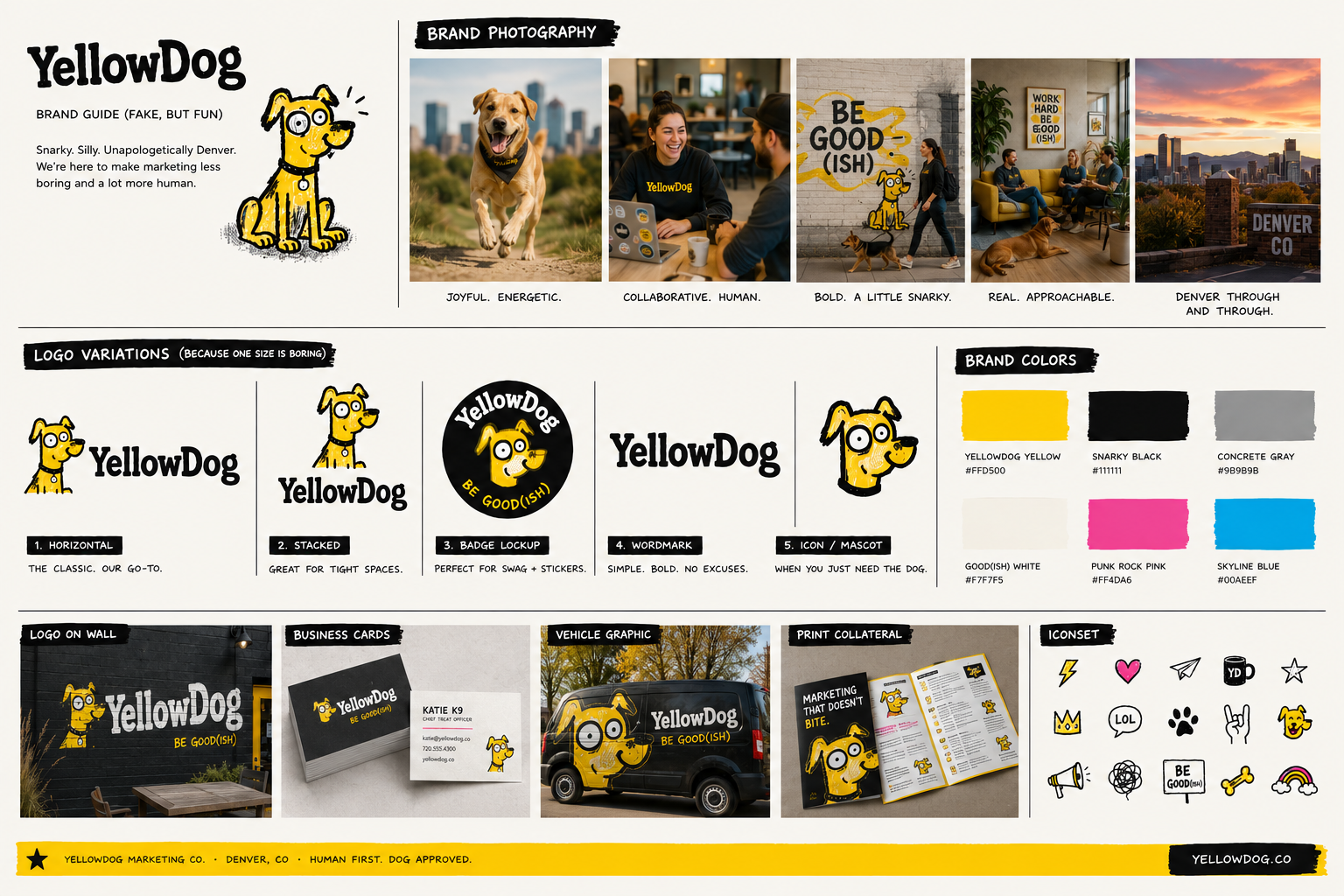
- Five different logo variations means five separate files to recreate from scratch, not one clean master file. And this isn’t a simple logo. Everything from the outline texture to the placement of those wonky eyes needs to be recreated, and there’s no guarantee it’ll match up exactly.
- Speaking of that logo, either this dog is aging in real time or our AI image generator saw a squirrel. The dog in the black circle has a white muzzle and one black spot that’s kind of similar to but not the same as the white shading and black nose you see on the final logo. And why does the dog up top have a grey eye?? These are the questions we need to be asking.
- Inconsistencies leave us to make the call on actual color codes and create everything accordingly.
- It doesn’t tell us what fonts to use or how to duplicate that fun, funky typography. Of course it’s something we can duplicate (or, honestly, improve). Just know that’s a job, too.
- AI-generated icon sets come out generic and, frankly, a little goofy. Look closely—is that little dog looking forward and to the side? Now that’s just creepy.
- Mockups of the logo on a wall, business card or van look great, but they’re really just images of what it could look like, not print-ready files we can actually send to production.
- That brochure? Cute, but you’d still need to pay a professional to recreate the layout and, oh yeah, figure out what the words are actually supposed to say.
- That AI photography is lovely for a mood board. Unusable for an actual ad or brochure.
None of these issues make it useless. It’s a genuinely great starting point for figuring out the own vision before sitting down with a designer, brand consultant or photographer. As long as you use it for what it is—a brainstorm, not a blueprint.
Just ask my bestie.
I recently called out ChatGPT for veering from the brand guide it had just created. And it told me exactly what I needed to hear.
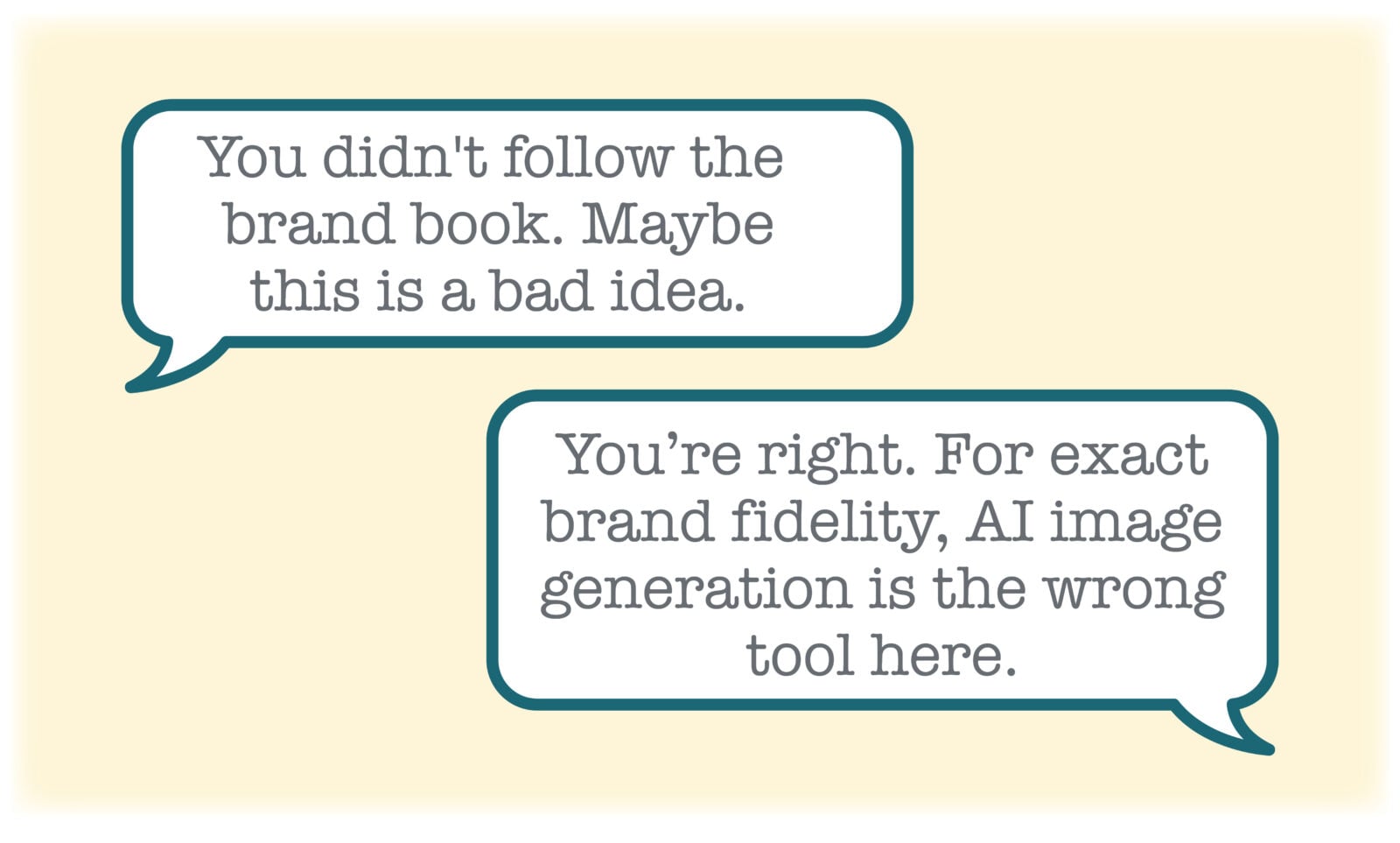
Me: You didn’t follow the brand book. Maybe this is a bad idea.
Chat: You’re right. For exact brand fidelity, AI image generation is the wrong tool here.
Better approach: build the flat thumbnails as designed files from the actual brand guide/assets—not “generate” them. That means layout them in Illustrator/Canva/Figma-style artboards using the real logo, colors, fonts, and elements.
Don’t ditch AI. Just set up some loving boundaries.
Listen, it happens to the best of us. There’s nothing like the rush of a new friend or a life-changing new tool. But, honestly, if we got matching tattoos with every cool girl we met in the bathroom line, we’d be running out of space. Every thrilling new relationship eventually finds a reasonable place in our well-balanced lives.
So I’m not telling you to quit AI cold turkey.
Use it. Brainstorm with it. Let it help you find the words for your next campaign or rough out a concept to bring to your team. That’s a genuinely good use of the tool (one we even use ourselves).
Just don’t ask it to be your designer. When it’s time to build something that actually has to work—print beautifully, scale down to a favicon, get embroidered on a hat, hold together across years of marketing—that’s when you want a real, live, human in your corner.
Chat pals come and go. YellowDog friends are forever.